
Navigating the complex world of cryptocurrency investments requires a thorough understanding of its unique tax implications. This article outlines 5 key tax considerations for crypto investors, covering crucial aspects such as capital gains taxes, taxable events beyond simple buy and sell transactions, the importance of accurate record-keeping, the impact of different jurisdictions’ tax laws, and strategies for tax-efficient crypto investing. Understanding these factors is vital for minimizing your tax liability and ensuring compliance with IRS regulations (or equivalent in your country).
Understanding Capital Gains Tax on Crypto
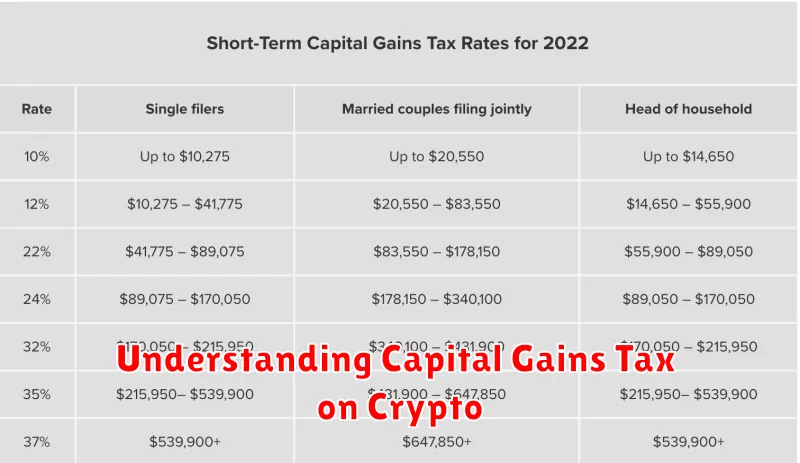
Cryptocurrency, while a relatively new asset class, is subject to the same tax laws as traditional investments. Understanding how capital gains tax applies to cryptocurrency is crucial for responsible investment and compliance.
The tax implications of cryptocurrency transactions hinge on how it’s treated. For tax purposes, the IRS generally considers cryptocurrency as property, similar to stocks or real estate. This means that any profit realized from the sale, exchange, or use of cryptocurrency is considered a capital gain, subject to taxation.
The tax rate on capital gains depends on several factors, including your income level and the length of time you held the cryptocurrency. Short-term capital gains (assets held for one year or less) are taxed at your ordinary income tax rate. Long-term capital gains (assets held for more than one year) are taxed at preferential rates, generally lower than ordinary income rates.
Calculating your capital gains involves determining the cost basis (the original purchase price) of your cryptocurrency and subtracting it from the proceeds received upon sale or exchange. This difference represents your capital gain or loss. It’s essential to keep accurate records of all cryptocurrency transactions, including purchase dates, amounts, and transaction fees. This documentation is vital for filing your taxes accurately and avoiding potential penalties.
Tax reporting for cryptocurrency is similar to reporting other investments. You will need to report your gains and losses on Schedule D (Form 1040), “Capital Gains and Losses.” The specific form and reporting requirements might vary depending on the complexity of your cryptocurrency transactions and your overall tax situation. Consult with a tax professional to ensure accurate and compliant filing.
Tax laws related to cryptocurrency are constantly evolving. Staying informed about the latest updates and guidance from the IRS is crucial for maintaining tax compliance. Resources available on the IRS website, as well as consultation with a tax professional, are recommended for navigating the complexities of cryptocurrency taxation.
Tax Implications of Staking Rewards

Staking, a process where cryptocurrency holders lock up their assets to support a blockchain network, yields rewards. These rewards, however, have significant tax implications that vary depending on your location and the specific cryptocurrency. Understanding these implications is crucial for responsible cryptocurrency investment.
In many jurisdictions, staking rewards are treated as taxable income. This means that the value of the rewards received, calculated at the time of receipt (fair market value), is subject to income tax. The specific tax rate applied depends on your individual tax bracket and applicable laws in your region. It is important to note that this is not universally consistent and differs across countries.
The tax basis of your staked cryptocurrency also plays a significant role. If you staked cryptocurrency purchased at a certain price, the subsequent rewards will be taxed based on the difference between their fair market value at the time of receipt and your original cost basis. This could result in both capital gains taxes and income taxes being applied. This complexity necessitates meticulous record-keeping.
Furthermore, the frequency of reporting is another key factor. Depending on your local regulations, you may be required to report staking rewards annually or even more frequently. Failing to accurately report and pay taxes on staking rewards can result in substantial penalties and interest charges. It’s crucial to consult with a qualified tax professional to ensure compliance.
Record-keeping is paramount. Maintain detailed records of all staking transactions, including the date of receipt of rewards, the quantity of rewards received, and their fair market value at the time of receipt. This documentation will be essential when filing your tax returns. The IRS, for example, strongly emphasizes the importance of maintaining such records for cryptocurrency transactions.
In conclusion, the taxation of staking rewards is a complex area with significant implications for cryptocurrency investors. Consult with a tax advisor or specialist familiar with cryptocurrency taxation in your jurisdiction to ensure you are complying with all applicable regulations and to minimize your tax liability. Proactive planning is essential to navigate the intricacies of this evolving landscape.
Reporting Crypto Income Accurately

Accurately reporting cryptocurrency income to tax authorities is crucial for maintaining compliance and avoiding potential penalties. Understanding the various types of crypto transactions and their tax implications is paramount.
Capital gains are realized when crypto assets are sold for a profit. The profit, calculated as the difference between the selling price and the original purchase price (or cost basis), is typically taxable as either short-term or long-term capital gains, depending on how long the asset was held. Accurate record-keeping, including purchase dates and prices, is essential for determining the capital gains tax liability.
Mining cryptocurrency is considered taxable income. The fair market value of the cryptocurrency mined at the time of receipt is treated as income. This income is typically reported as ordinary income and is subject to the applicable income tax rates.
Staking and lending cryptocurrencies often generate rewards or interest. These rewards are also considered taxable income and must be reported accordingly. The value of the rewards at the time they are received is usually the taxable amount.
Trading cryptocurrency frequently can lead to complex tax situations. Each trade, whether resulting in a profit or loss, generally has tax implications. Using specialized tax software designed for crypto transactions can significantly aid in accurate reporting.
Gifting or donating cryptocurrency also has tax implications. The giver may be responsible for capital gains taxes based on the difference between the original cost and the fair market value at the time of the gift or donation. The recipient might also have tax liabilities, dependent on various factors.
Given the complexity of cryptocurrency taxation, seeking advice from a qualified tax professional is highly recommended. They can help navigate the intricacies of crypto tax laws and ensure accurate and timely filing of tax returns.
Failure to accurately report crypto income can lead to significant penalties, including fines and interest charges. Proactive and meticulous record-keeping is the best approach to prevent such issues.
Tracking Crypto Transactions for Compliance

The increasing adoption of cryptocurrencies presents significant challenges for regulatory bodies and businesses alike. Tracking crypto transactions for compliance purposes is crucial to prevent illicit activities such as money laundering, terrorist financing, and tax evasion. This requires sophisticated tools and strategies to navigate the complexities of decentralized and pseudonymous transactions.
Blockchain analysis plays a central role in this process. By analyzing the blockchain’s public ledger, investigators can trace the movement of cryptocurrency across various addresses and exchanges. This allows them to identify patterns and connections, potentially uncovering suspicious activity. Advanced algorithms are used to identify clusters of transactions linked to known criminal networks or high-risk individuals.
Know Your Customer (KYC) and Anti-Money Laundering (AML) regulations are critical in combating financial crime in the crypto space. Exchanges and other businesses handling cryptocurrencies are required to implement robust KYC/AML procedures to verify the identities of their customers and monitor their transactions for suspicious activity. This includes verifying addresses, identifying beneficial owners, and reporting any potentially illicit transactions to the relevant authorities.
Despite the inherent challenges of tracking cryptocurrency transactions, advancements in blockchain forensics and data analytics are improving the capabilities of law enforcement and regulatory agencies. These tools enable them to uncover hidden connections and trace funds even when efforts are made to obfuscate their origin or destination. Continuous monitoring and real-time analysis are essential for effective compliance.
The future of crypto compliance hinges on collaboration between regulatory bodies, law enforcement, and the cryptocurrency industry. Developing clear regulations and implementing robust technologies are crucial to balancing the benefits of innovation with the need to prevent financial crime. This requires a concerted effort to address the challenges and ensure a secure and compliant crypto ecosystem.
How Different Countries Tax Crypto

The taxation of cryptocurrency varies significantly across different countries. There’s no global standard, and the way crypto is treated can depend on several factors including classification (is it a currency, property, or something else?), holding period (short-term or long-term), and the specific transaction (trading, mining, staking, gifting, etc.).
Some countries treat cryptocurrency as a capital asset, similar to stocks. This means profits from selling crypto are taxed as capital gains, with the tax rate depending on the holding period and the investor’s income bracket. Examples of countries that largely follow this approach include the United States, Canada, and Australia. However, even within this model, complexities arise; for instance, the US considers crypto mining income as taxable income, separate from capital gains.
Other countries classify crypto as a currency. In these jurisdictions, transactions may be subject to the same taxes as traditional currency transactions, such as sales tax or VAT. This approach is less common, but it highlights the diversity of regulatory frameworks across the globe.
A third category treats crypto more like a commodity. This approach focuses on the underlying asset rather than its function as currency or an investment. The tax implications are often similar to those of trading precious metals or other raw materials. The specific tax rates and regulations vary widely, making it crucial to understand the precise legal landscape in each jurisdiction.
Furthermore, many countries are still developing their crypto tax laws. Regulations are constantly evolving, making it essential to stay updated on the latest developments. The lack of clarity and harmonization across nations presents a significant challenge for both taxpayers and businesses operating in the cryptocurrency space.
It’s crucial to consult with a qualified tax advisor or legal professional to determine the correct tax implications of your cryptocurrency activities in your specific location. The information provided here is for general knowledge purposes only and does not constitute financial or legal advice.
